
Baby Got Backrooms
A bit about creepypastas, liminal horror, fractal spaces, and movies that are spiritually video games.
If you’re not careful and you noclip out of reality in the wrong areas, you’ll end up in the Backrooms, where it’s nothing but the stink of old moist carpet, the madness of mono-yellow, the endless background noise of fluorescent lights at maximum hum-buzz, and approximately six hundred million square miles of randomly segmented empty rooms to be trapped in. God save you if you hear something wandering around nearby, because it sure as hell has heard you
Kudos to the anonymous 4channer who wrote this, a great example of the poetry that can arise from the punchiness of the poster style. There’s a reason a few sentences and one improperly white-balanced image of a furniture store in Oshkosh, Wisconsin, spawned a whole creepypasta category. The phrase “noclip out of reality” is especially resonant, an elegant shorthand for the metaphysical dynamics at work—you could expound on how there’s another universe alongside our own that you can accidentally fall into, or you can evoke the concept with a simple video game term.1
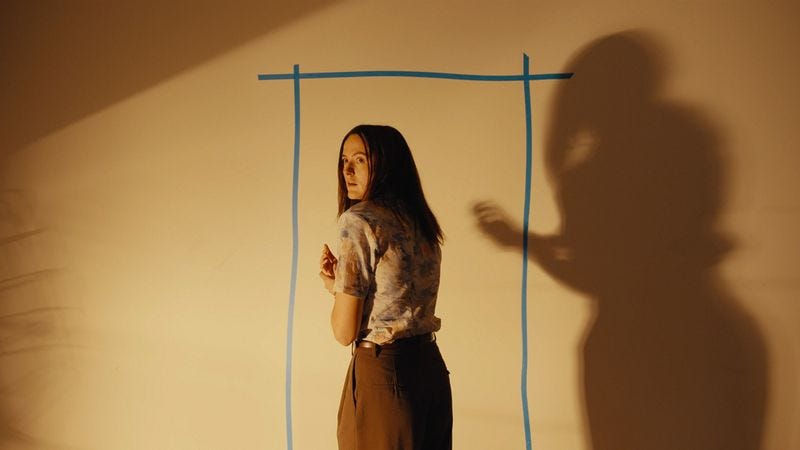
Kane Parsons has done more than anyone else to create a world within the Backrooms framework,2 first through his popular YouTube series and now with a feature film. Already a fan of the webseries (shout out to Micah Gottlieb for including its inaugural installment, The Backrooms (Found Footage), in a great short film program in LA in 2022), I was quite taken with Backrooms the film, which is handsomely produced and often effectively creepy. I’ve been running the silly phrase “30,000 square feet of liminal spaces” through my head a lot since I read it, but there’s no denying the queasy thrill of watching characters navigate its tangible logic-defying sets.
To me, the appeal of both the Backrooms and its umbrella category of “liminal horror” is simple. We live in a world of increasing alienation, of third spaces devoured by workplaces, consumption nodes, and the ugly infrastructure that ferries us to and from them. What if you were stuck in that lifeless in-between? What if that nothingness went on forever? (For Gen Z and Alpha, there’s also the unmistakable haunt of COVID, as my friend Carol delves into here, along with a great exegesis on Parsons’ interest in analog horror.) Any intelligent exploration of such concepts will naturally pivot on the relationship between people and their environments, heightening the ways cinema already incorporates such elements.
There’s no mention of noclipping in Backrooms, but its understanding of space is still heavily informed by video games. Last year, I had a lot of fun writing an article for Little White Lies about how films channel gaming experiences (sometimes successfully, sometimes not—sometimes purposefully, sometimes not), and I’d unhesitatingly slot this among the ranks of movies that are spiritually gamelike. Call it ludo-essentia cinema. (One of my Substack drafts is a post that goes even more into Movies That Are Video Games, because I find the subject invigorating and there’s so much I wasn’t able to get into with my Little White Lies piece.) Each time someone ventures into the Backrooms, the film takes on the distinct vibe of watching a game run—emphasized by the first-person point of view it adopts in its found-footage segments. The emphasis is on the characters probing these spaces, and through such interactions, learning about this other world and how it works.
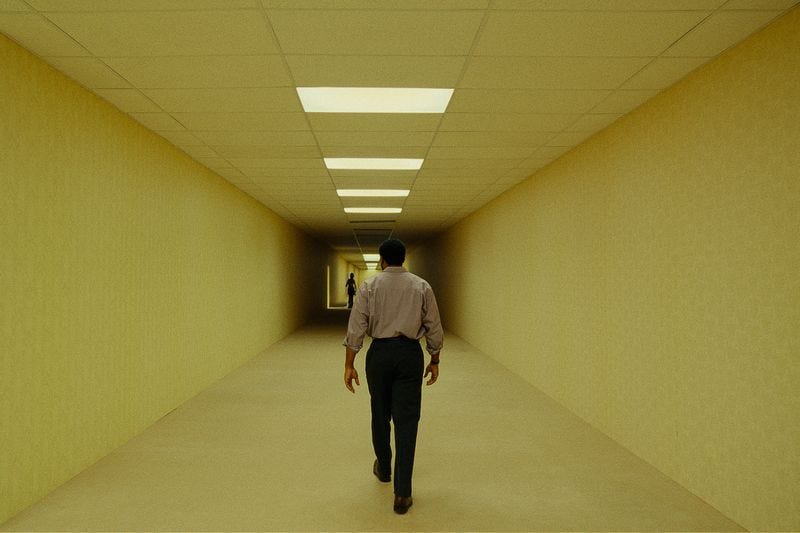
In this, Backrooms is similar to this year’s Iron Lung, an actual adaptation of a game that is almost entirely such sequences. In fact, that other film could be read just as much (possibly even more so) as an adaptation of director/writer/producer/star Mark Fischbach’s Let’s Play of Iron Lung as it is of the game itself. Let’s Plays are an important aspect of creepypasta culture. Some stories are straight up fake Let’s Plays, sometimes for real games (parts of the infamous Ben Drowned (incidentally, my first creepypasta) take the form of a Let’s Play for Majora’s Mask). Beyond that, many creepypasta videos are structured in this exploratory “watching a video of someone else playing a game” mode. I’ve written for the MIT journal Immerse about how vicarious gaming has become its own form of entertainment, and this is one way that form has bled into other media. Games offer a visceral, immersive thrill in their stories, and a whole ecosystem of voyeurism and second-order experience has developed alongside it. It’s a 21st-century version of the nested accounts comprising classic novels. Instead of an H.P. Lovecraft character stumbling upon an eldritch journal entry, you are the one finding a stray missive from a terrifying other world on YouTube.
The mise-en-scène also takes many cues from gaming rather than traditional cinema. The most obvious example is when Renate Reinsve’s character finds a wall scrawled with deranged pictures and rantings that hint at the nature of the Backrooms and the unholy creatures within. This is a familiar trope, of course. But in a movie or TV show, you’ll generally see some simple phrases repeated over and over that are easy for the audience to parse, or a blurry block of text that signals insanity well enough without them having to pay attention to its specifics. But here, the wall is dense with legible information, and the words and pictures are arranged in a tableau that makes more sense as something to be absorbed at length than in passing. It’s begging to be paused, looked over (and, naturally, shared as a screenshot), and picked apart. Another great instance is the Backrooms facsimile of a furniture showroom where the film’s climax takes place, which could easily be a boss battle location in a Resident Evil or Remedy game. It’s spacious, with objects arranged in circles that are placed to be dodged between and provide cover, interspersed with plot-important devices.
Games and creepypastas also cross-pollinate in how they incorporate lore. Tidbits ranging from errant dialogue to minor background details are made to be scrutinized and theorized over. From these scraps, viewers/readers/players build a greater understanding of these worlds. Games like the works of From Software are built with the assumption that their player bases will crowdsource a collective comprehension of their stories, the same way they can aid or attack one another via online connections. Backrooms, thankfully, is completely understandable without any prior knowledge of the creepypasta or Parsons’ series, but it’s still subsumed in this grammar through the way its characters interface with their circumstances.
The Backrooms are a fertile setting for this sensibility because fractal locations lend themselves so well to gaming. A number of games take place wholly or partly within spaces mundance or majestic that endlessly iterate, loop, and shift—among them The Stanley Parable, Manifold Garden, My House, PT/Silent Hills, Antichamber, Superliminal, the Alan Wake games, The Exit 8 (itself made into a movie released this year) Control, NaissanceE, and the Portal series (an influence Parsons has explicitly cited on Backrooms). Jacob Geller has made multiple interesting videos about the impossible architectures of game worlds. Here’s a good one:
There are other referents for Backrooms. Another high-grossing horror movie made by a 20-something that came out this May was directly inspired by a Simpsons Treehouse of Horror segment, and this one too has a direct forebear: “Homer3”—itself based on the Twilight Zone episode “Little Girl Lost.” If Parsons hasn’t seen either, then the extremely similar way that Chiwetel Ejiofor’s character marks out the door between worlds is an interesting bit of creative convergence. And looming over almost every liminal horror story is Mark Z. Danielewski’s House of Leaves, whose style of heavy footnotes, nested accounts, and hypertextual structure presaged many of the tropes of creepypastas.4 Additionally, given that the film takes place in San Jose (Parsons grew up on the other side of the Bay, in Petaluma), it’s surprising that no one mentions the Winchester Mystery House. The #1 precedent I would recommend checking out, though, is Susanna Clarke’s Piranesi, as well as its inspirations, the capricci of Giovanni Piranesi.
Another obvious touchstone is a great deal of Borges stories. The man’s capacious imagination often turned to variations on conceptualizing infinity. Adam Nayman cites “The Aleph.” Kim Newman name-checks “The Library of Babel” (along with House of Leaves and others). “The Garden of Forking Paths” is right there. The one that resonates most with Backrooms to me, though, is “The House of Asterion,” which tells the myth of the Minotaur in the Labyrinth from the creature’s perspective. It is a disquieting portrait of self-delusion—Sisyphus in Plato’s cave, convincing himself he is happy. In the same way, Ejiofor’s failed architect finds manic satisfaction in mapping and exploring the Backrooms. One could easily read this passage from “House of Asterion” in his voice:
Another ridiculous falsehood has it that I, Asterion, am a prisoner. Shall I repeat that there are no locked doors, shall I add that there are no locks? Besides, one afternoon I did step into the street; If I returned before night, I did so because of the fear that the faces of the common people inspired in me, faces as discolored and flat as the palm of one’s hand.
Reinsve tells Ejiofor that our habits and thought patterns are loops, and she tries to teach ways to break unhealthy ones. Video games are also predicated on loops—cycles of failure and learning that inform how to approach them. Backrooms doesn’t try to explain what the titular dimension is, but its characters suss out that it is some kind of echo of the real world, a tumor of poorly made replicas of places (and, horrifyingly, people) that get weaker in their replication the more distant the echo gets. Or, if you want to indulge an AI metaphor, they are a being without experience or intelligence, hallucinating things based on reality, whose patterns it can recognize but whose qualities it can’t understand.
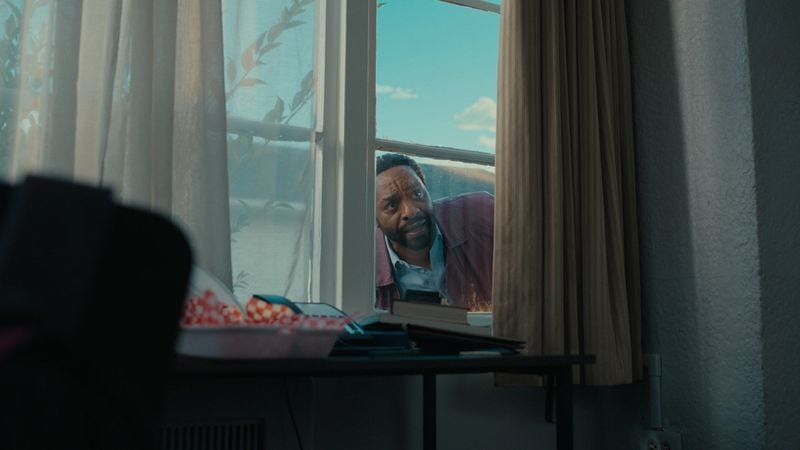
The Backrooms are a place of memories made real, except they are faded and imperfect, the way memories are. Entering them is thus a way for each character to grapple with their pasts—gameplay loops of unproductive self-obsession. Ejiofor, who cannot stop wallowing in self-pity, is consumed by the Backrooms. Reinsve, who has done her best to put her unhappy childhood behind her, is repulsed both by being there (this sunless world is too resonant with the way her mother kept her indoors—another psychic imprint of COVID) and by how enthusiastically Ejiofor has acclimated to it.5 The allegory is simple, but it tracks well, which is strangely rare for horror movies these days. Gratifyingly, it is not simply About Trauma the way so many such films insist upon. (A lot of the dialogue shaping the metaphor is unfortunately pretty clunky, but I forgive it.)
Undergirding Backrooms media (and many creepypastas—and, well, a lot of horror) is the morbid compulsion to learn more. Characters get lost in the Backrooms, and you keep reading more, keep clicking on more videos to see where things go next. One of the most impressive things about Backrooms is its circumspection about this compulsion. In many horror films, defeating the monster is an easy allegorical vector for transcending one’s personal issues. This movie disavows that there’s any use—any point, even—to entering the Labyrinth and fighting the Minotaur. It gets the appeal of the loop, but is unnerved by its seduction. To paraphrase Alan Wake, maybe it isn’t a circle, but a downward spiral.
The morning sun reverberated from the bronze sword. There was no longer even a vestige of blood. "Would you believe it, Ariadne?" said Theseus. "The Minotaur scarcely defended himself."
That’s all for now. Look at her yawn:

For those who don’t know, “clipping” is basically the programming that keeps your character inside a game’s world, so “noclipping” is anything (usually a cheat or a glitch) that lets you bypass that programming, letting you phase through such boundaries.
There has been some discussion about whether the Backrooms idea counts as an “intellectual property” or a “brand” regarding the feature film and the YouTube series’ originality. Until we collectively settle these distinctions in the thorny area of collaborative internet fiction, “framework” is the word I’ll go with.
There’s no footnote; this was just the only way I could figure out how to put a superscript number in Substack’s drafting system.
Here’s where I confess that I abandoned my attempt to read House of Leaves. After years of being intrigued by and game for it, I found its prose a chore, and was particularly disinterested in how so much of it is dedicated to describing a film, which is a kind of media mixing I don’t think it pulls off. But maybe I should give the book another shot sometime.
But look, we’re adults here. We can admit that we’re all curious about how the Still Life tastes, yes?