'A Beautiful Dichotomy' — an Interview with Bill Morrison
Bill Morrison talks about his practice and film rediscovery, preservation, restoration, and access.
I conducted this interview with filmmaker Bill Morrison in June 2024, tied to Reassembly: The Films of Bill Morrison, Metrograph’s retrospective of his work. I was unable to find an outlet to run the piece, so it was originally published on my ill-fated earlier attempt at a newsletter. That site is gone, so I’m giving the interview a new home here.
Certain filmmakers have a lot in common with sculptors. Until relatively recently, cinema worked by translating celluloid, a tangible material, into moving images and (sometimes) sound. The projector did the work your mind does in taking words on a page and making them real. There are many artistic possibilities in disrupting that process.
Bill Morrison is one such disruptor, purposefully using poorly preserved, degraded film materials. He recontextualizes orphaned clips into new stories, traces the “life story” of a particular print, or finds out how 500 reels came to be buried in the Yukon. More recently, he’s also worked with digital archival materials. His 2024 short Incident, for instance, uses a multi-channel view of security camera and police body camera footage to investigate the police killing of Harith Augustus in Chicago in 2018.
I sat down with Morrison in Manhattan to discuss the works and his practice, as well as film discovery, preservation, restoration, and access. This conversation has been edited and condensed for time and clarity.
Dan Schindel: Film is often described in mystical terms, as if it’s all made of light. Your works remind us of how celluloid is a firmly physical medium. What led you to this interest?
Bill Morrison: I worked in film exclusively in the ‘80s and ‘90s. The great animator Robert Breer was my professor at Cooper Union. He showed me the entire American avant-garde, specifically Ken Jacobs, and I was introduced to the [Library of Congress] Paper Print Collection through his film Tom, Tom, the Piper’s Son [1969]. I think the “Aha” moment for me with nitrate was seeing Peter Delpeut’s Lyrical Nitrate [1991] at Film Forum when it came out. The last four or five minutes of that film show decay; I think a lot of people remember it as being entirely decayed, but in fact it’s mostly pristinely preserved and titled in identified films. But those last five minutes were a springboard for me.
And there was the Orphan Film Symposium. The first one was, I think, in 1999, held at the University of South Carolina, which I heard had an old and decaying collection of newsreels entirely on nitrate. So when I was down there, I stole away to their library and started searching exclusively for footage that showed emulsion deterioration. That first day, I found [the clip of] the boxer and the nuns, and that was the genesis of Decasia. From then on, I had a path to follow.
In the time since, there’s been this broader wake-up call around film preservation. There’s much more awareness of the issues at hand. You’ve seen the conversation change. Has it also affected your access and capabilities?
Definitely. When I started working on Decasia in ‘99, archives were hermetically sealed worlds with overlords and minions, and there wasn’t great communication between them. During that research process, I was young, naive, and unknown. I was going to them, saying, “Do you have any deteriorated films?” And I was met oftentimes by people saying, “No, we don’t keep deteriorated films, we preserve films.“ They were horrified by this idea.
But inevitably, I would find a person closer to my age who would talk to me, to get around the administration. There was this feeling I was doing something radical with the archive, and the younger people supported that. I really think that the community built around the archives, the narrative has changed around them and how institutions could collaborate. We’re all trying to save this stuff together. We’ve seen that happen over these last three decades.
The digital revolution also happened in that time. Now things can be scanned rather than you having to go places—or god forbid, someone having to make a VHS tape and send it to you. The entire landscape has changed. Emails rather than faxes. When we talk about 30 years, we’re really talking about archaic technologies.
My reputation also started to precede me, and people understood what I was trying to do and how I could bring attention to the archives and their mission. So rather than being brushed off or reviled, people were coming to me and saying, “Hey, we have this stuff. Would you be interested in working with it?”
Have any particular archives or resources proved especially useful, whether in the long run or in recent years?
Traditionally, I was going to the Fox Movietone outtakes at the University of South Carolina. Whenever I was looking for a subject in the mid-to-late ‘20s, that would be my go-to. I had a special relationship with the nitrate vault at the Library of Congress in Culpeper when the division was run by Mike Mashon. It’s in transition right now, and I don’t know whether I’ll ever recreate that relationship. George Willeman has been incredibly helpful. In some ways, he’s an associate producer or a collaborator with me in identifying things that are going to be thrown out that I might be interested in.
The digital age has also opened up new ways for things to get lost. It’s not that they’re old and singular. Instead, innumerable materials can be lost in the plethora. You see this recently with the surveillance footage from the Chicago Police Department used for Incident.

At the same time that archives have become more open, we’ve seen escalating consolidation of studios and other entertainment entities. Has that affected your ability to use any copyrighted materials?
It has. I mean, whatever, people need to protect their property. Recently, there was a case with footage I shot of a musician who’s quite elderly now. I didn’t think he would have an issue being represented as he was 30 years ago, but he did, so I have to respect that. I pay licensing fees for a film like Dawson City. Something I know will get distribution is going to be vetted. You need to get an insurance policy, you need to show everything’s all good. I have designed a lot of my career around stuff that evades that, stuff in the public domain.
But I think that also brings in an interesting point. Why is something in the public domain? If something is in the public domain and is free to examine, then it should be embraced as such. Going back to police surveillance footage, if this is available to everyone, if anyone can download it, what does that mean?
There’s also the question of access. Richard Misek has addressed how much Getty mediates access to materials that are theoretically fair use.
There are people who position themselves as middlemen for footage that is extensively free. So it becomes an issue of where to get a copy. I guess the musical equivalent is that you pay a licensing fee for publishing and another for the master copy. So if Getty owns the master copy, you might have the right to the publishing, but you don’t have the right to that film. So, going to an archive and getting a copy of that copy can circumvent that.
Many of your films have this ghostly quality, grappling with mortality, which contrasts with the physicality and enduring nature of celluloid.
It’s a beautiful dichotomy, right? We have this thing that exists and lasts, and we have precious few of those now. We don’t have things that we can hold that last as much, we’re increasingly putting all our communication and images into something truly ephemeral. Cinema is a brilliant distillation of what it means to have a body and mind. When this physical thing is threaded and light passes through it, it becomes this life in a different plane. I just followed that model as far as it would go.
Within the frame—especially these nitrate frames, you have greater silver content and resolution than anything we’re used to seeing in a theater—one half could contain these images, and the other half could be completely destroyed. So that ephemerality exists within a single picture, this dissolution. Which I think we all live with, if you think of the frame as a single day or a moment. We all live with the possibility that we could not exist from moment to moment. We try to put that out of our minds to get through our day, but that is the condition of being alive.
What you said about celluloid’s physical structure reminds me of something Jan-Christopher Horak said: “Five hundred years from now, someone could look at a strip of film and probably reverse-engineer a projector from it.“
That’s why archivists generally have settled on the notion that a 35mm reel is a Rosetta stone. Any possible future civilization could look at one and eventually figure out how to see it, that it’s made of individual frames that are projected. These are vessels we can send off into time—as has been said over and over, much more than any digital format.
There’s also the fact that individual film reels and frames have their own stories, built each time they’re shown and in how they’re stored and shipped, making each copy unique. Dawson City and The Village Detective make this even more explicit.
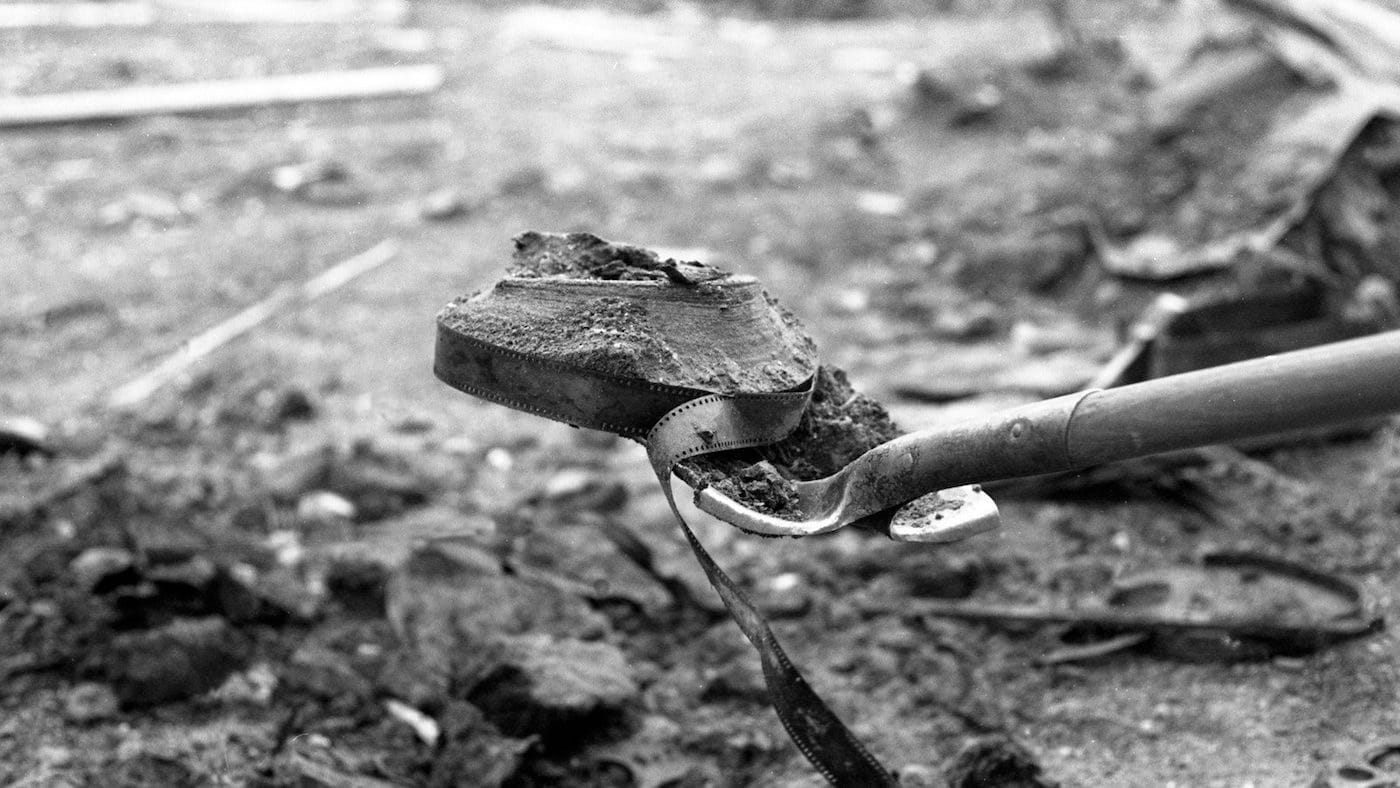
With Dawson City, there was this idea that all these reels followed different paths to come together. First, they had to get onto that exhibition circuit, and then, instead of being dumped in the river or put into a bonfire, they were the ones selected to be put in the old defunct library. From there, they had to make it to the swimming pool. And then there was a fire on top of that pool, and they had to make it out, and the ones that made it through all that became the 500 reels that were dug up. They were all marked with that special Dawson decay. I think about how each of those reels had a different path, but the last mark was that of Dawson City.
I think of that Black Sox footage in those reels. Back then, the World Series was nine games long. So they’re shooting all these samples of this series that are condensed into a single newsreel. It’s this element of chance governing what moments are remembered.
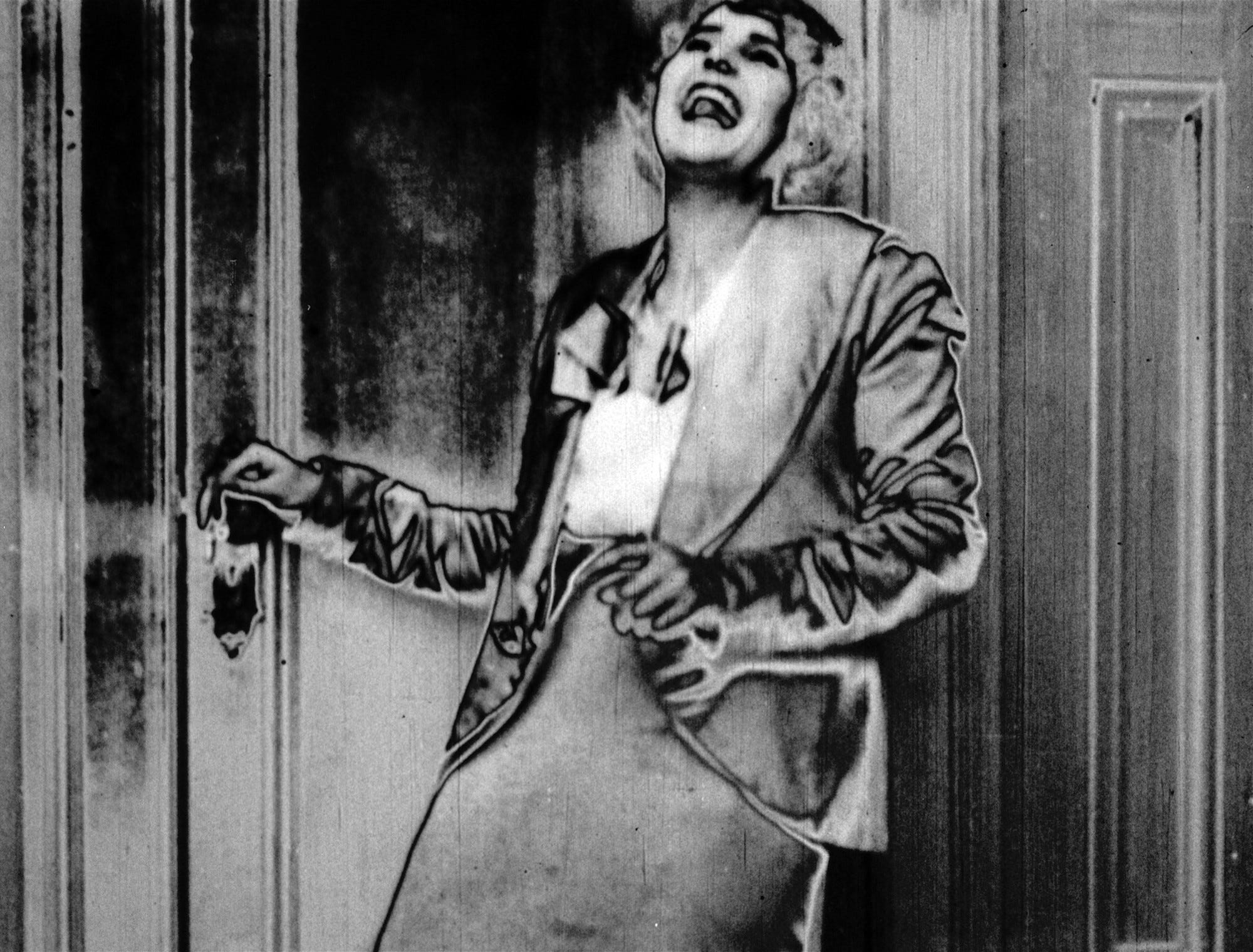
Light Is Calling was a real blessing. Its source material is James Young’s The Bells, from 1926. There was a pristine print in the Library of Congress, and early in our relationship, George Willeman said, “We’re chucking this print that has nitrate decay in three or four reels. Would you be interested in seeing it?” Back then, we didn’t have digital scanning, so I manually rolled through this reel. It’s kind of a miracle, because most nitrate melts together and flakes, but this one unleaved beautifully and cleanly. Cinema Arts made an optical negative, per my instructions, from this print. I think of how that other, pristine print had gone through another life and had arrived at the same vault intact, while this one had reels that decayed. It didn’t destroy the film, but it destroyed the image. I have no idea what humidity or atmospheric conditions or other decisions affected these two different reels. But the ugly sibling came to me.
You mentioned having a lab make copies to your specifications. When working with these materials, how much of it can you handle directly, versus what you have to instruct someone else to do?
For a time, I worked exclusively with Cinema Arts, Janice Allen’s lab, and we were going film-to-film. A very easy and common way of blending two frames to create slow motion was done optically, where we multiplied frames—I think it was four to one with Light Is Calling—at 50% exposure, backed it off, knocked it off-sync by two frames, and did the same pass so that every frame was double-exposed either with itself or an adjacent frame. That created this incredible flow, since I was slowing it down four to one. Instead of it being basically a slideshow, it created cinema again.
Similarly, when I was working on Highwater Trilogy [2006], there was no print of the original nitrate negatives coming from South Carolina. Rather than create a print, we bought up the remainder of a 35mm reversal stock and created a reversal negative from the original negative. Therefore, we were only one generation off from the original camera negative. Today I work with Colorlab, and they’ve done amazing work. Once I discovered that I could scan nitrate directly with them, my process became that if I was to get something—for instance, from the Library of Congress—I would go down there first, make sure it could unreel, fix splices, see if I wanted it and that it was safe to handle. And then I found that they could even do things like soak reels to loosen them up so it was safer. I think they were horrified the first time I sent them a job, but now it’s like, “Okay, this is Bill Morrison’s stuff.“
Have any recent celluloid rediscoveries caught your eye, or are there any that you hope could be made?
There’s a rumor that the DuMont Network—the fourth television network—dumped their Kinoscope archive in New York Harbor. I’ve long been intrigued by the idea of all that sitting there underneath the silt next to the Statue of Liberty. That’s a dream project. It’s a long shot, but technology has advanced to the point where you can draw circles around possible sites. Especially with shallow water like that, our capacity has increased to see what’s on or below the surface. I’ve met someone versed in that stuff and am trying to see how much we can find out before spending a lot of money dredging anything—hopefully somebody else’s money.
There’s also a rumor that Fox dumped all its silents in the Pacific after the talkies came in, and now there’s a reef of silent film off of San Pedro. Of course, that’s really deep water, largely inaccessible. And others dispute the story, so who knows? But there’s no question that lots of film history is at the bottom of our oceans, and we’ll continue to find it.
But it’s much more likely that discoveries will be made because most archives, even small ones, can now afford good scanners. For instance, someone finds a reel labeled “unknown,” and they can determine, “Oh, this is not an unknown film; this is Tod Browning’s The Unknown.“ Mysteries like that can be solved because instead of having to thread something up on sprockets, which is very dangerous for a film, you can put it on a plate and scan it and have a beautiful digital copy. So we’re finding things buried right underneath our feet. I think rather than going looking for the Titanic, or Cleopatra’s boat, or the Endurance, things are showing up where we would expect them to—on shelves. We just have to identify them.
Thanks to Kaila Hier and Marija Silk at Metrograph for facilitating this conversation, and to Peter Labuza for identifying the source of the quote about reverse-engineering projectors from film reels.
That’s all for now. Here’s Ursula, looking straight out of an Ancient Egyptian wall painting: