
Discoursure Day
A post about 'Disclosure Day,' the latest Spielberg.
Disclosure Day ends by cutting away before Emily Blunt’s newswoman can relay a fugitive alien’s speech to the world. All we hear is the first word: “Listen.” It’s the film’s button on its appeal to empathy, a quality we’re told the aliens value as “the ultimate evolutionary advantage.” It also recalls Kurt Vonnegut, who interspersed “Listen" as an exhortation throughout his books, most notably Slaughterhouse-Five. I can easily imagine Disclosure Day as a Vonnegut novel, though its vibe would be very different from how it plays out in director Steven Spielberg’s hands—heavier on the absurdism, more ironic, but equally sincere in its pleas for empathy. I think Spielberg once arrived at a good approximation of Vonnegut’s tone; collaborating with Kubrick brought A.I. to a midpoint of their respective sensibilities that strikes the right melancholy.1 Brian Aldiss wrote science fiction in the same era as Vonnegut, and there are lines laced with similar existential matter-of-factness in “Supertoys Last All Summer Long,” the basis for A.I. “You ask such silly questions, David. Nobody knows what real really means. Let’s go indoors.”
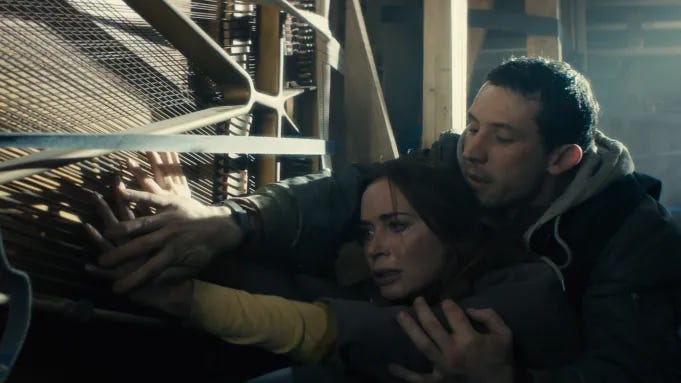
I thought of Vonnegut and A.I. because the deeply felt conviction in those works is nearly absent in Disclosure Day. Early on, Josh O’Connor’s character tells his girlfriend that it’s easier to show her a clip from the vast trove of top-secret material about the aliens that he’s trying to leak than it would be to explain things to her. The movie then spends much, much more time describing the aliens and what the US government has done with/to them rather than showing anything. The miscalculation in how much the film withholds visual information vs. how it uses it is frankly baffling, coming from the guy who made Jaws and Close Encounters of the Third Kind. The titular “Disclosure Day”2 sequence musters a fraction of its intended heft, mostly comprising approximations of known “real UFO footage” that lack the eeriness such artifacts can carry because of how obviously Hollywood CG they are.
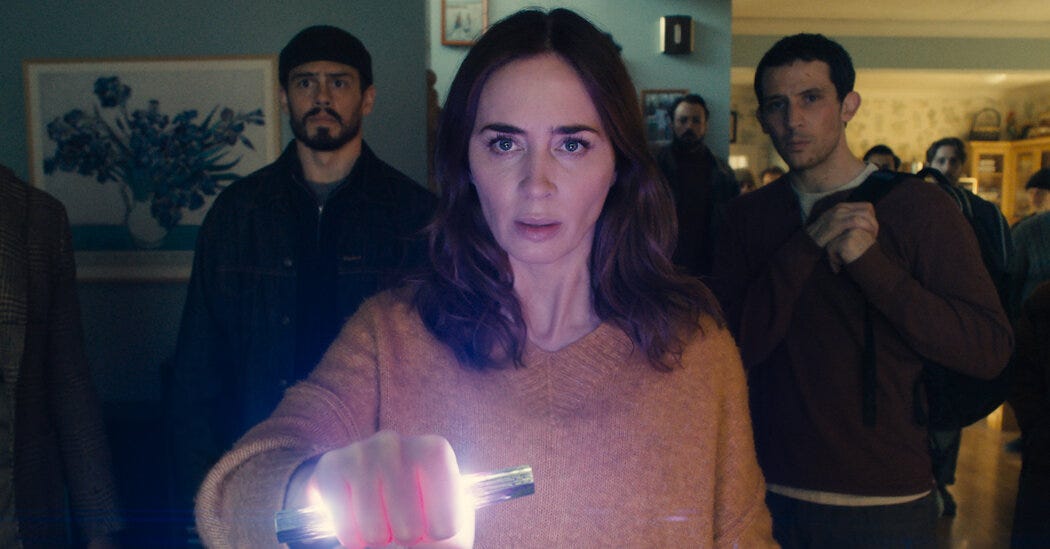
Spielberg and especially David Koepp are ill-suited to something this talky and theoretical. The characters question what reality-changing information would mean both personally and socially without spurring any introspection in the audience. Many problems are solved via Blunt’s character deploying nebulous mind powers to make others do whatever she wants, which is indicative of the awkwardly functional way the story imagines “empathy.” It’s also deeply haphazard in grappling with contemporary image-sharing culture. It’s aware of smartphones, appropriately circumspect about them, and not quite sure how to incorporate them into sequences of people beholding things with awe—something Spielberg is so well-known for that they have a term for it. It has more DNA in common with The Post than it does Close Encounters, dedicated more to high-minded but ill-supported talk about what certain knowledge means than to simply conveying the knowledge visually.
The Post, at least, had some good process stuff about the workings of journalism; Disclosure Day’s triumphant news moment is an embarrassment in its contextless stream of images. You can see the intent to recreate the psychological flurry of processing the world through modern media, but compressing it into one shitty (and quite bathetic) newscast feels more like a dodge from actually depicting this. What’s frustrating is that I think if Spielberg cut loose, he could easily and excitingly evoke the interplay between the real world, traditional media, and social media. He loves to play with roving cameras and to compress a lot of information by nesting images with screens, reflective surfaces, and elements that separate parts of the frame. I think he might be held back by trepidation about and/or lack of understanding of the technology in question.
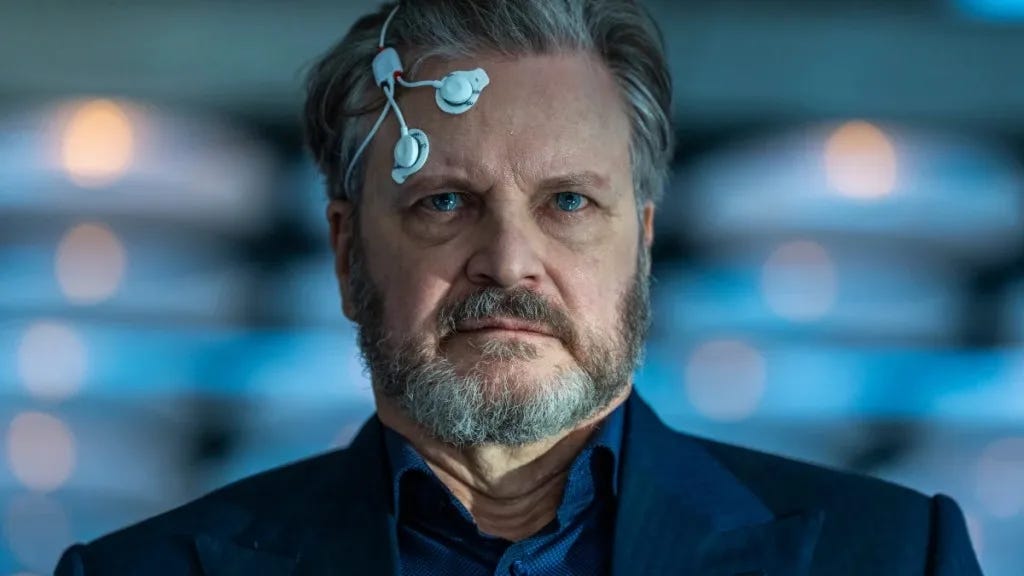
There are flashes of Spielberg’s well-known visual ingenuity throughout Disclosure Day. A character’s offscreen face is seen in the knife she’s poised to strike with. As Colin Firth’s villain and his underlings suss out who in their organization has gone rogue, the traitors’ faces are reflected in glass, letting us see both them and Firth and company, making them participants in the scene rather than mere subjects of conversation.3 But just as often, the movie flails for an interesting angle. Sometimes the camera simply circles the characters in search of urgency, which feels like it’s from a mean-spirited parody of the Spielberg/Kamiński style4 rather than the genuine article. John Williams’ score is similarly rote, to the point of being forgettable. And Michael Kahn’s absence from a Spielberg for the first time in decades is sorely felt; though editor Sarah Broshar assisted Kahn multiple times, her work feels more imitative of his style than truly in its spirit. Unsteady, momentum-tripping pauses are frequent. On a macro level, the movie can’t build suspense, which is pretty ruinous for a thriller. There’s a particularly bad string of scenes in the first act that cuts away from each character at the perfect time to rob their individual threads of any tension.
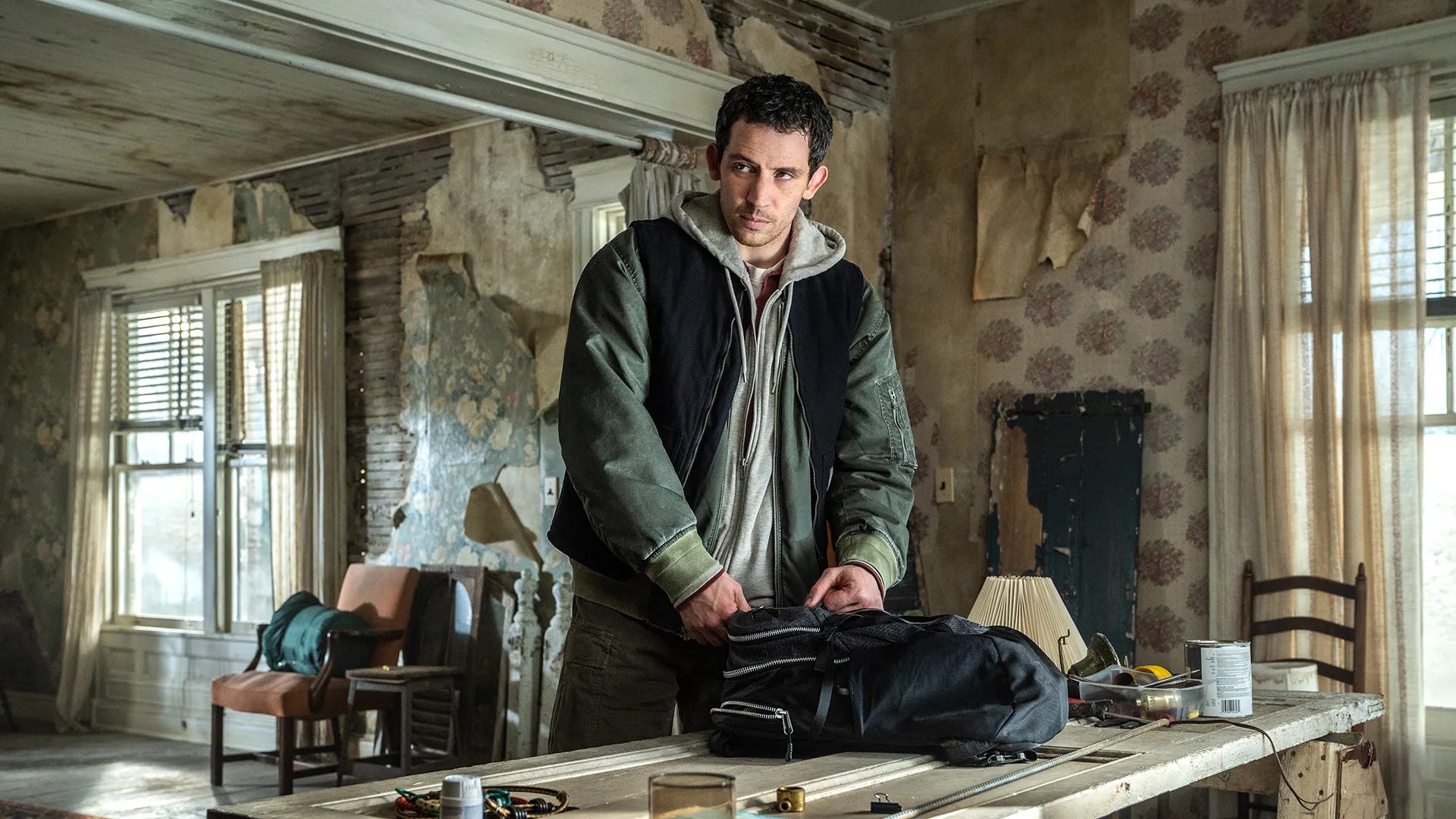
Many of Disclosure Day’s issues are downstream of this general low-energy funk. Most of this two-and-a-half-hour movie is devoted to an extended chase rather than any of its themes. The film is loath to spend too much time on conversation before it gets back to the bad guys pursuing the good guys. And that pursuit is just not compelling. I’m not sure that this can be attributed to Spielberg losing his touch, considering how locked in he was on West Side Story and The Fabelmans just a few years ago. Still, there are multiple weak sequences here that I couldn’t imagine him fumbling before, even in his lesser films. In the ‘90s, he would have made henchmen pratfalling through an invisible house and getting owned by invisible firetrucks the basis for a full five-minute sequence, exploiting every variation of the idea he could think of, instead of using the concept for a few gags before discarding it. The chase that starts at the farmhouse and ends with a car going over a cliff is immediately one of the worst action scenes of his career, utterly lacking any sense of danger as a horde of villains ineffectually paw at and keep just behind the heroes at a slow clip, easily fooled and thwarted by the smallest inconveniences and flimsiest feints.5 The scene that feels the most dangerous, in which O’Connor and Blunt have to climb onto a moving train from a car getting crushed under it, is still weakened by an overuse of CGI enveloping its practical aspects.
The biggest disappointment comes when Spielberg’s visual interest finally meets some of the movie’s ideas. There are many teases of Colman Domingo’s crew building a Nathan-Fielder-style replica of a house inside a larger warehouse. It turns out to be a recreation of Blunt’s childhood home, meant to help her and O’Connor remember their childhood abduction by the aliens. That’s a rich, fascinating concept. It’s also not what happens. What happens is that the two sit in one room and do all the remembering there by thinking really hard. There’s no linking of space to thought, of movement through a familiar space to movement through memory. We barely even see any of the house that’s been built up so much for us (and Blunt). These characters are sketched so thinly—given a few screenwriterly distinguishing attributes and nothing else—that we have nothing personal for them to latch onto, and for us to then identify with. The twist that O’Connor is an “experiencer” like Blunt is tossed off, and the recovery of their buried memories spurs no bond between them—in fact, from then on, he’s basically perfunctory in the story. And then there’s the sheer oddness of how much their abduction experience scans as an allegory for childhood sexual abuse, only for it to be revealed that the traumatic event in question was in fact benign.
The world is supposed to be on the nuclear brink in Disclosure Day. But all we get of that are vague newscasts and one scene of people crowding a store to buy supplies, none of whom seem particularly pressed. Through an accident of weak scripting, it semi-accurately captures the weird mundanity of going through your regular day against the backdrop of calamity on your screens. Unfortunately, it’s also another way the movie fails to sell its stakes. Spielberg can’t get a handle on the alienation of modernity. Most of the actually interesting friction in the film emanates from that alienation.6
The best demonstration of this is the viewers who have speculated about how much the footage of government agents killing and torturing aliens at the end is meant to evoke Gaza. This is going to keep happening, by the way. Movies that don’t intend any parallel will hit upon it, because invoking the familiar imagery of mass slaughter is going to remind us of what’s in our social feeds. We saw this just last year with Superman, which was written before 10/7 with Ukraine and Russia in mind, but could not escape the Gaza comparison. The suffering of Palestinians does not trouble anyone in positions of power in the film industry enough for a blockbuster film to confront one of the major obscenities of our time head-on, but it will bleed into pop culture regardless. It’s like if Hollywood never bothered to temper the way it depicted building destruction in the wake of 9/11. People will still make the connection; that’s how empathy actually works.
That’s all for now. She presents as an animal:

The most Vonnegutian film I can think of remains Jonathan Demme’s lovely American Playhouse adaptation of the Vonnegut short story “Who Am I This Time?”
Still can’t get over that they seriously put that in a chyron.
And then, bafflingly, even though they identify early on who is missing from work, it isn’t until Firth is doing a psychic mind dive on Domingo’s character and sees two of his compatriots that it occurs to him to track where those characters have been going. I’m doing my best to keep Cinemasins stuff out of this, but this script is very half-assed.
Or a J.J. Abrams film.
Seriously, the bad guys suck in this. It’s like a whole army made solely of the guys from the one scene in the E.T. re-release whose guns were digitally swapped for walkie-talkies.
The movie’s most Big Lib quality, courtesy of Spielberg and Koepp—even more than however much handwringing over Gaza you might read into it—is blaming an impending world war on ill-defined North Koreans. That’s a fairly noxious bit of racist shorthand coming from a story that’s pleading for us all to have more empathy.
Man the more I think / read about this movie the more I hate it. Script is bad to begin with but also a complete mismatch with Director